

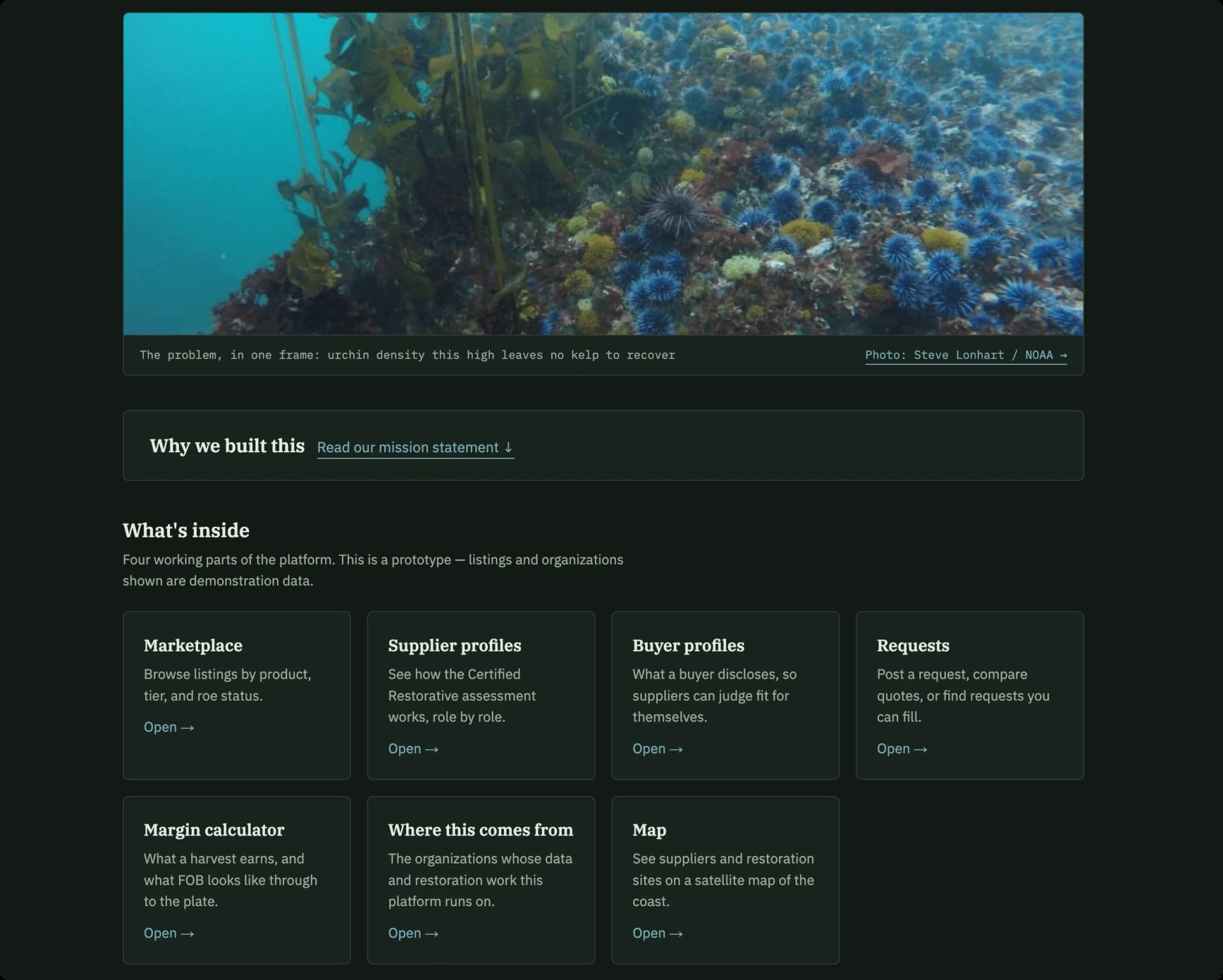
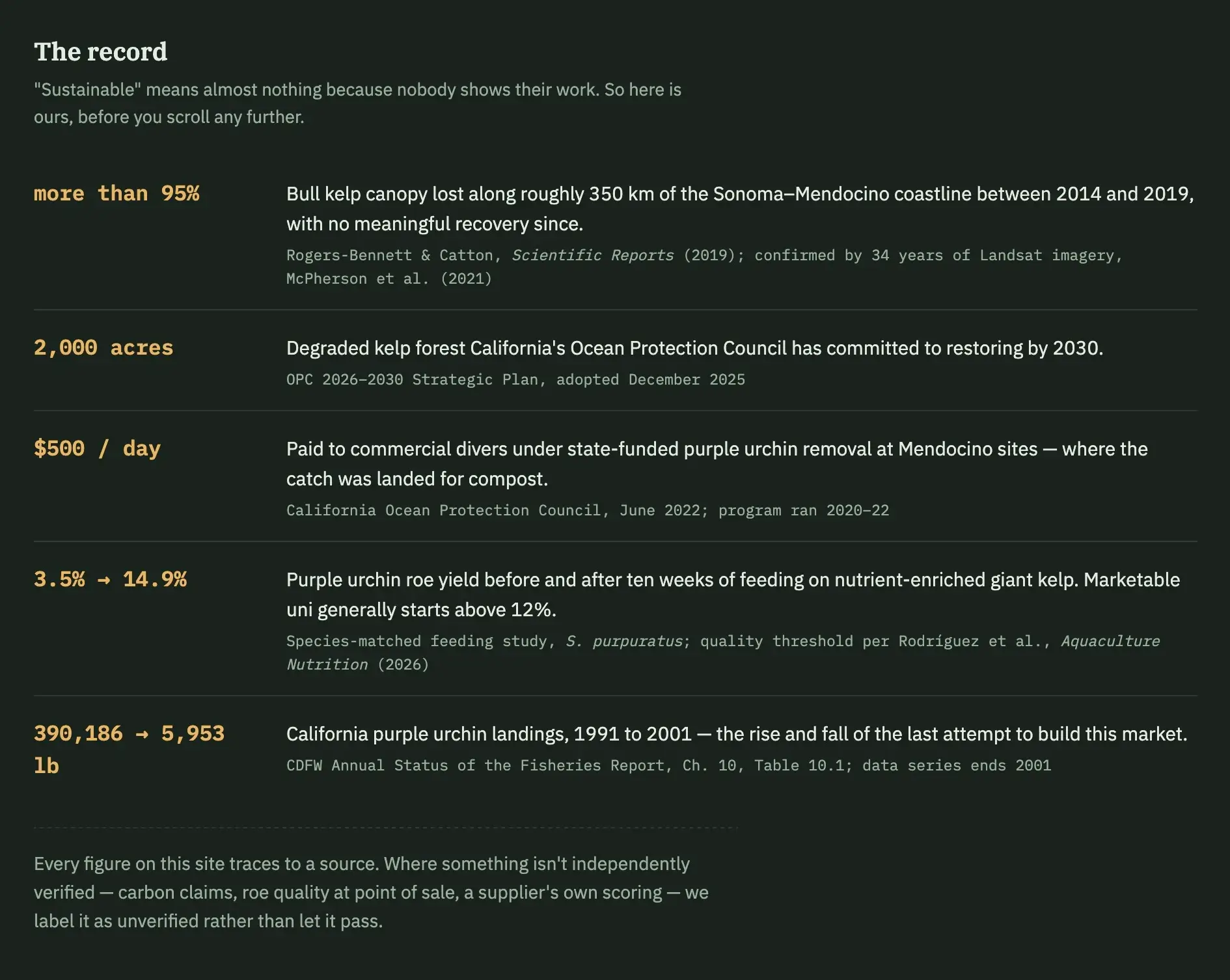
Dan Bollwinkel has fished the Pacific his whole life and spent more than a decade working for a B Corp in a Northern California seaside town. Between 2014 and 2019, more than 95% of the bull kelp canopy along roughly 350 km of the Sonoma and Mendocino coastline disappeared. It has not returned.
Dan came into Terra Studio a self-described AI skeptic. He came out with KelpConnect, a prototype marketplace for kelp and purple urchin restoration.
California has paid commercial divers around $500 a day to clear purple urchins from barren rock, and much of that catch is landed for compost. Fed properly, whether through restored kelp or onshore urchin labs, those same urchins can move from a 3.5% roe yield to 14.9%. Marketable uni generally starts above 12%. That is money going into compost because there is no market to capture it.
KelpConnect is Dan’s attempt to build one. Every listing asks the same question: does this help the kelp forest return, or does it merely avoid doing further harm?
It is a prototype, and Dan is clear about its limits. The listings use demonstration data, restorative assessments are self-reported, and the work of building a market remains ahead. Underneath it sits a 29-page ground-truth file where every prompt, decision, verified fact, and source is documented in a structure another person or agent can use.
Dan on the inspiration and build
Dan Bollwinkel Terra.do Alders Studio 2026 KelpConnect: Project Debrief
The Inspiration:
KelpConnect is a conceptual restorative aquaculture marketplace tool that serves as a connection, resource and information hub for people and organizations working on Bull Kelp deforestation off the California coast. My inspiration to build KelpConnect as a capstone project for the Terra.do AI Studio stemmed from a personal interest in addressing a climate change driven ecological crisis that has altered the ecosystems and economies of communities up and down the west coast of North America. Kelp forests are comparable in scope to the biodiversity found in tropical rainforests or coral reef systems. As Charles Darwin once said: “Yet if in any country a forest was destroyed, I do not believe nearly so many species of animals would perish as would here, from the destruction of the kelp.”
My interest in the Bull Kelp crisis is tactile; both as a life-long Pacific Ocean fisherman and having spent a decade plus working for a company based in a seaside community in Northern California that was transformed in my time there by the disappearance of these once dense underwater forests. The company I worked for was a B Corp, and a model of sustainable CPG business practices that was deeply involved in local ocean-based philanthropic efforts. I was fortunate enough in my time there to raise funds through direct sales proceeds and to collaborate first-hand with these organizations on impactful public fundraising events. The passion and the range of people I encountered working on this daunting scenario was life-altering. Finding myself in the Terra.do ecosystem in my career pivot into more direct climate work, first in the LFA program and then Studio, my topic of study was apparent from day one.

The scope of this crisis requires intervention from a terrific variety of angles and stakeholders: none more important than the members of the communities most impacted by the disappearance of what for generations, eons really, had been a source of nourishment, biodiversity and protection from the cyclical power of the relentless sea where exposed coastlines bear the brunt of near and far away storms and swells. The native tribes of coastal Northern California hold vast historical knowledge and a paramount stake in the health of their land, further adding to the human investment in the return of the kelp. We all face headwinds: political and climatological, with a pending “Super El Nino” and record global ocean temperature rise.
But there is hope that comes in many forms. From marine biologists working full time in labs and in the cold barren water to rejuvenate the near extinct Sunflower Sea Star, to scientists and volunteers planting kelp spores and monitoring patches of restored coastline, to the divers who once and still work as commercial fisherman pulling exploding populations of purple sea urchins off the rocks. These urchins left unchecked by the disappearance of the former (Sunflower Sea Stars as predators and Kelp as a food source) have left behind barrens where kelp fronds once stood growing upwards of 2 feet per day. As well the policy drivers in Sacramento and in communities all over the state who recognize the circular economic consequences of a crisis such as this, and the need for civic intervention and public funding where possible.
KelpConnect intends to serve as an opensource tool that can be picked up by any of the aforementioned stakeholders: it is there to be shaped by them, by the members of the communities and tribes that have lost the most both culturally and economically, and by the people who through restorative aquaculture, advanced marine science or simply spreading awareness, still see hope in restoring our underwater forests.
The Build Process:
I came into the Terra.do AI Studio a skeptical neophyte when it came to AI. My primary exposure was through the cacophony of media and the gradual adoption of those around me. My foremost goal was a deeper understanding of a technology that for better or worse was shaping our present-day existence. What I left with, beyond a cherished place in a community of like-minded individuals from all over the world with diverse backgrounds and interests, was a furthering of the understanding I sought. Though hard to shake in the noise of our present-day attention economy and still legitimized by the behavior of my government and the tech industry’s fiscal malevolence, my anxiety around the actual function of AI as a useful technological tool is no longer on the doom spectrum. I also left with a belief that if the direction of this technology is pointed not just toward extraction and the enhancement of capitalist systems and efficiencies, that it could become a force multiplier and an invaluable tool in accelerating climate mitigation and adaptation efforts.
KelpConnect began with my personal interest and exposure to the Bull Kelp crisis in Northern California as I understood it at the start of studio: I certainly had the advantage of prior exposure. But when I began slowly to work with Claude (of all the leading AI labs, Anthropic continues to prove the “least ethically problematic” in my estimation, and Claude’s UI was personally more amenable to me compared to other AI’s) as simply a thought partner I found the scope of my knowledge on the topic and my exposure to new organizations, active policy initiatives, hard data and real science expand exponentially. In concert with the progression of the AI Studio coursework, I learned how to verify the information I was uncovering, and to sharpen my interactions with Claude to improve efficiency and outputs in each run through. KelpConnect started as a concern, it evolved to a project concept, it was shelved mid-course to focus on deep learning and practice around AI use through the rigorous assignments of the course, then re-addressed with new knowledge and understanding of things like general instructions, effort level adjustments, global context, project instructions, and an ever-growing library of skills for agents and sub-agents to deploy that I learned to customize based on necessity. The introduction of other AI’s, productivity apps and connectors furthered possibilities and the complexity of the build at every step.
One of the many “a-ha” moments that the course provided as I prodded my concept along was the realization that holding AI accountable on many altitudes was key to successful work: I learned how to argue with Claude, to force Claude to challenge my own assumptions, and to maintain control as the thought provider and to let Claude work as a facilitator and a thought partner. Much like the first time I got behind a wheel of a self-driving car, it was nearly impossible to cede complete control. I learned quickly that efficiency and expanded access to resources and information allowed me to organize ideas, to compile data and to create actual “products” from this work beyond written summations. My professional experience as a copy editor came especially in handy drafting mission statements, summations and briefs: AI writing is not good, and easily spotted. It was heartening for me personally to know that element of human creativity cannot be easily replicated, certainly to my standards anyhow, by AI. This process of layered project creation as I had experienced it academically and professionally in the past was now compressed from weeks to days to hours. I would find myself isolating to work on the tougher assignments and in my own builds and getting into what I would call “flow states” where things happen so remarkably stopping is difficult: there is dopamine involved! And I think an awareness of that is also something the course gave me: it’s fraught and needs to be accounted for!
Along the way the aforementioned isolation of deep creativity inspired me to ground my ideas and my concepts through exposure to real-world stakeholders. In one instance I was faced with real AI backlash that I was fortunately able to overcome through thoughtful communication. And another hour and a half conversation with the director of a Marine Science Center shifted the ground underneath all of my assumptions and led to the framework of KelpConnect as it currently stands. When I am out fishing with people who do not often spend time on the ocean I am always keen to remind them that you must maintain three points of contact, two feet on deck and one hand on the rail, at all times, especially in building swells. Working with technology this powerful is analogous.
To reach the presentation finish line, though my project is ongoing and I am currently seeking a broader range of stakeholder feedback, I relied heavily on the interactions and feedback of my peers in the studio. Our collective struggles and successes were essential in the process and weeks after completion we’re still relying on each other as we hone our respective builds for real world deployment.
KelpConnect is multifaceted and it contains numerous elements of AI web design that I picked up along every step of the way in Studio, and so far, it is functional as a potential tool on the aspects outlined at the onset of this writing. But perhaps what I am most proud of is what is under the hood of KelpConnect, or perhaps more apt, what makes up the framing of the endeavor. As it stands now KelpConnect rests on a 29 page “ground truth” file, with every step, prompt, tweak, design element, verifiable fact and all verified sources structured to be handed off to anyone or any AI agent in order to be multiplied and utilized in ways any similar scenario may see fit: they are myriad in our changing world. In this sense, I can only hope that it is…alive!
Where it goes next
Dan arrived skeptical and remained skeptical. He kept his own judgment at the centre of the work and used the tools to move faster through research, verification, and building. His line about three points of contact on a boat, two feet on deck and one hand on the rail, is a useful description of working with these tools.
KelpConnect is open for the purpose Dan describes. He is looking for feedback from marine scientists, restoration organizations, tribal representatives, divers, urchin ranchers, chefs, and buyers who know this coast and its work. If that is you, the prototype is here.
Terra Studio Intensive
Climate professionals work with AI on a problem they already care about, and finish with a prototype someone outside the cohort can open and use. Every fellow builds their own, the way Dan built this one.